The Ordinary UGC — Sheet First, Then the Video
Two prompts. The first turns two ordinary product photos into a six-panel reference sheet. The second uses that sheet to build a 15-second UGC video with a timed voiceover.
Have it running in three steps
- 1Copy the prompt
- 2Open ImagineArt
- 3Paste it and generate
What you'll need
30 min- ImagineArt
- Claude


A woman in a white robe stands against a deep green wall. She takes a bottle of rose hip seed oil out of its carton, drops it into her palm, works it into her face, and holds the bottle up at the end. Fifteen seconds, four stages, one voiceover.
The interesting part is not the video. It is that you write two prompts, not one. The first prompt builds a product reference sheet. The second prompt builds the video from it.
The whole process
- Take two plain photos of your product — the bottle and the box.
- Run the sheet prompt in an image model. You get one 3×2 sheet, six panels.
- Check the sheet: same product in all six panels, label readable, white background.
- Open ImagineArt and go to Video.
- Load three references: the sheet, a close dropper shot, and a face.
- Paste the video prompt and generate.
The two prompts
| What it makes | What goes in | |
|---|---|---|
| Prompt 1 | A six-panel product reference sheet | Two ordinary product photos |
| Prompt 2 | A 15-second vertical UGC video | The sheet, a dropper shot, a face |
The output of prompt 1 becomes Image 1 of prompt 2. That is the whole pipeline.
Build the sheet
The sheet is a 3:2 landscape canvas with six panels in a 3×2 grid. Three panels for the carton, three for the bottle. Carton straight-on, carton three-quarter, carton open with the bottle rising out. Bottle closed, bottle three-quarter, bottle open with the dropper beside it. Every state the video needs, decided once.
You feed it two ordinary product photos: one of the amber glass bottle, one of the white cardboard carton.
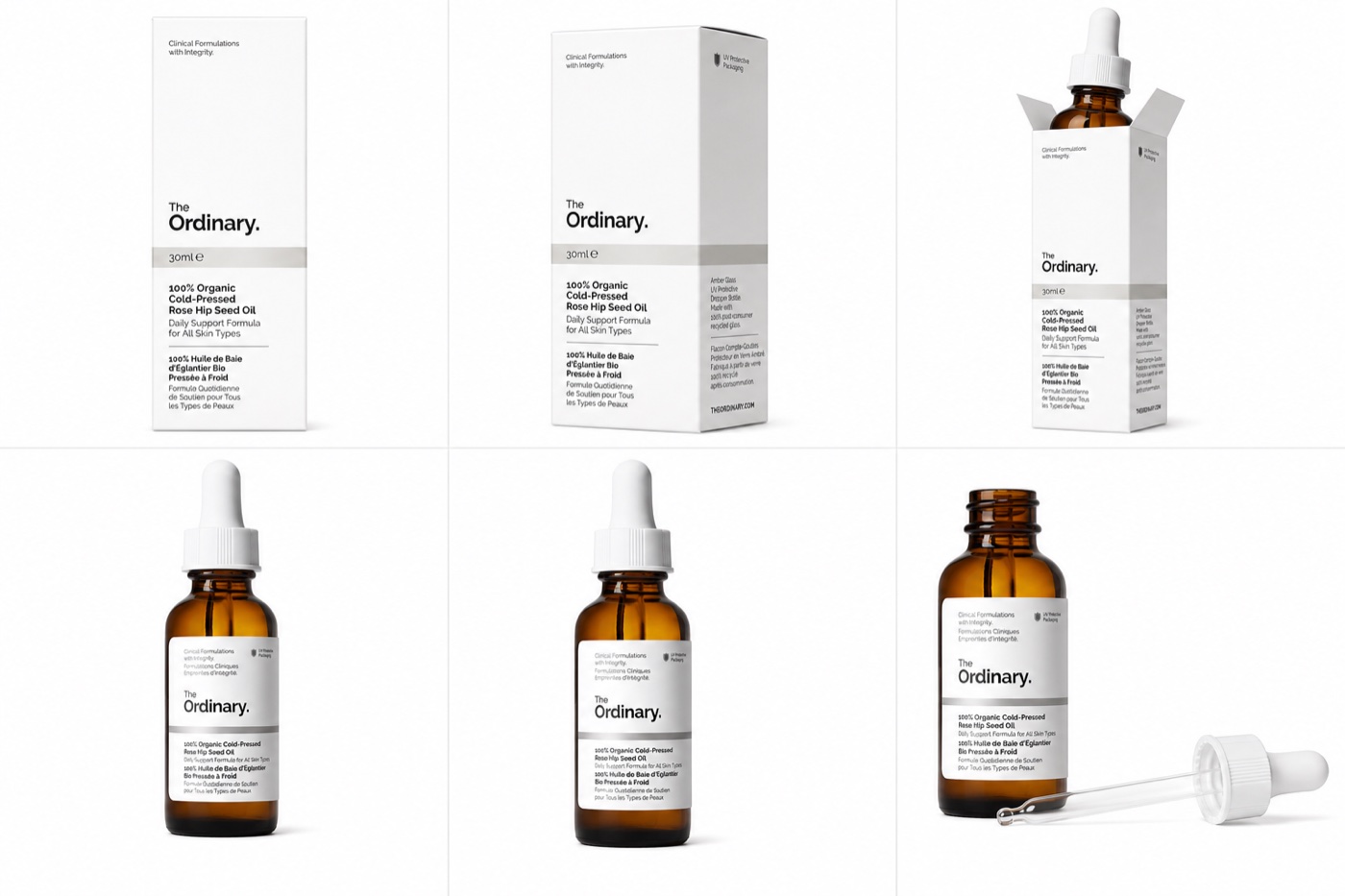
THE SHEET Product reference sheet. Landscape canvas, 3:2. Six panels in a 3×2 grid, evenly spaced, thin neutral gutters, no borders between them.
REFERENCE MAPPING Image 1: the amber glass bottle. Use its exact proportions, glass tint, dropper cap shape, and label artwork.
Image 2: the white cardboard carton. Use its exact proportions, printing, and panel layout.
Use these references for the product only. Do not carry over their backgrounds, shadows, reflections, hands, or any surrounding objects.
All six panels show the same single product. Do not invent variants, alternate sizes, or alternate colours.
PANEL LAYOUT Top-left: the carton standing upright, photographed straight-on, front face square to camera, full height in frame.
Top-centre: the same carton at a three-quarter angle, front face and one side panel both visible, printing legible on both.
Top-right: the same carton standing upright with the top flap open and the amber bottle rising vertically about one third out of the box. No hands in frame.
Bottom-left: the amber glass bottle standing upright and closed, white dropper cap in place, photographed straight-on, front label square to camera, full height in frame.
Bottom-centre: the same bottle at a three-quarter angle, closed, the label wrapping partly away from camera.
Bottom-right: the same bottle standing open with the dropper removed and the bare glass neck visible, and the glass dropper lying horizontally beside it on the surface — white silicone bulb at one end, clear empty glass tube at the other.
LABEL Reproduce the label artwork exactly as it appears in Image 1: identical wording, typeface, weight, line breaks, and position on the bottle. Do not re-typeset it, do not paraphrase it, do not add or remove any words.
LIGHTING AND SURFACE Seamless white studio background across the whole sheet. Soft large-source key from upper left, gentle fill from the right, one soft contact shadow under each object. The amber glass reads translucent with a warm internal glow where light passes through it. The white carton reads as matte uncoated board with visible paper texture, not glossy.
CAMERA Straight-on product photography, lens level with the middle of each object, no perspective distortion, everything sharp front to back.
CONSTRAINTS No panel numbers, captions, titles, arrows, or callouts anywhere on the sheet. No watermark. No additional logos. No hands, no props, no plants, no fabric, no coloured backdrop. No duplicate text. Only one carton design and only one bottle design across the entire sheet.
Three things in that prompt do most of the work.
Position-by-position layout. Each panel gets its own sentence and its own grid position. The model is not asked for “several angles” — it is told what goes top-left, top-centre, top-right, and so on.
Reference mapping with a limit. Image 1 gives the bottle, Image 2 gives the carton, and then: use these for the product only. No backgrounds, no shadows, no hands.
The label rule. “Do not re-typeset it, do not paraphrase it, do not add or remove any words.” Models love to rewrite small print. This line says no.
Load three references
The video prompt names three images. Each one is locked for a different reason.
Image 1 · SHEET. The six-panel sheet you just made. It defines the carton, the bottle, and the four product states the video needs.
Image 2 · DROPPER. A close shot of the dropper with golden-amber oil in the tube and a drop forming at the tip. The sheet cannot show that — it is a studio sheet, not a liquid shot.
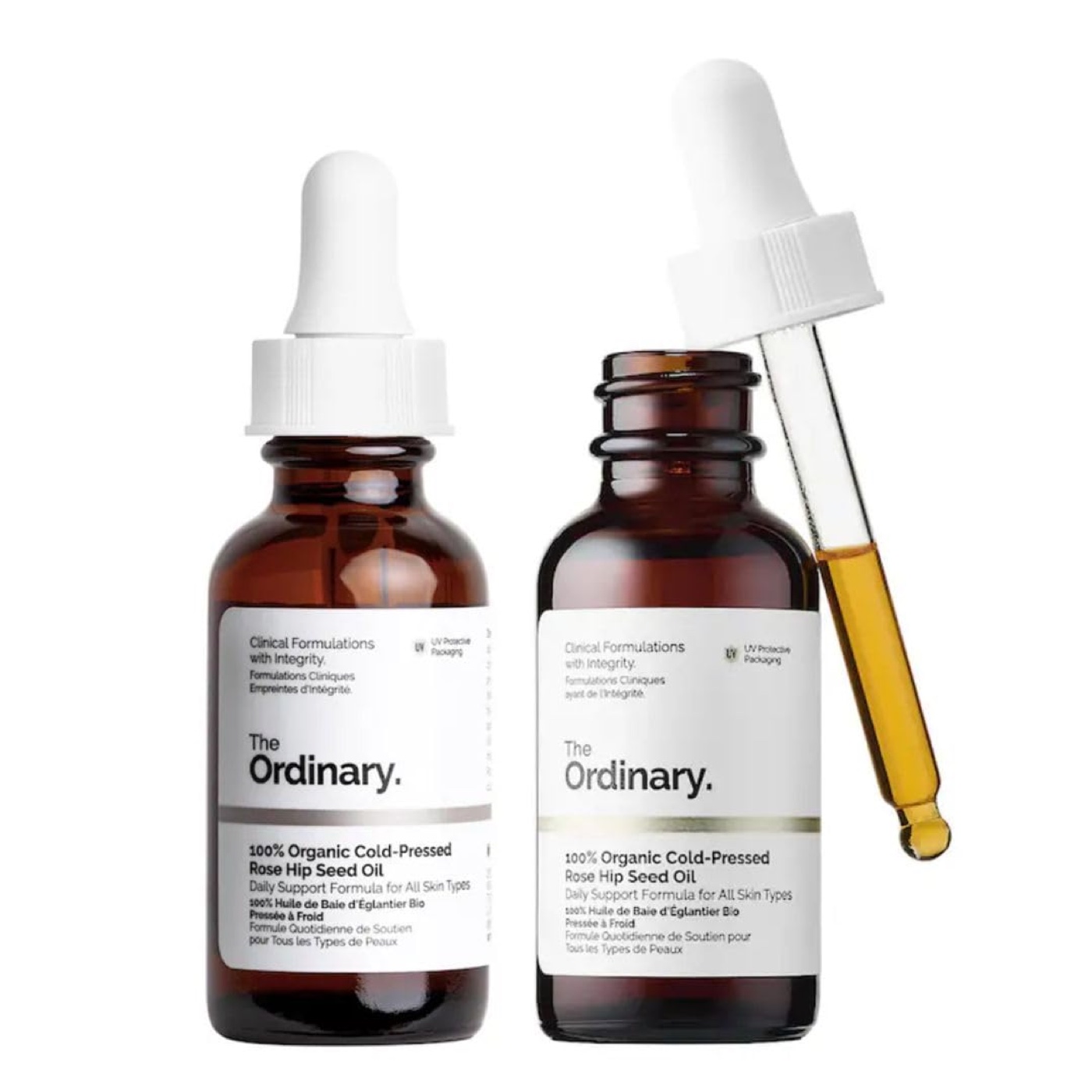
Image 3 · FACE. A plain face reference — face, identity, hair colour. The one in the source is a straight-on portrait of a red-haired woman on a neutral background, in a black t-shirt, with a neutral expression.
We are not publishing that image here. Use your own: a photo of yourself, or an avatar you generated. What matters is what the prompt takes from it and what it rejects. It takes face, identity and hair colour. It rejects hair texture, styling, the t-shirt, the background and the expression — because in the video her hair is wet and pushed back, and she is wearing a robe.
Paste the video prompt
Four stages. Each one has an initial state and an end state, so every cut inherits the one before it. The voiceover is timed to the same grid.
| Stage | Time | What happens | Voiceover |
|---|---|---|---|
| 1 | 0–4s | Bottle beside her cheek, carton rotated, bottle lifted out | “This is my secret…” / “It’s the 100% Organic…” |
| 2 | 4–8s | Bulb squeezed, three drops into her palm, one drop on her hand | “It hydrates, supports skin elasticity…” |
| 3 | 8–13s | Oil spread on her hand, two drops on her cheek, patted in | “It’s an oil-based formula…” / “Apply it in the evening…” |
| 4 | 13–15s | Bottle beside her face, closed-mouth smile to the lens | “You won’t regret it.” |
GENERATION GOAL Generate a 15-second vertical UGC-style skincare video, filmed as if on a phone by the woman herself. One woman, one product. The primary event: she introduces a facial oil, dispenses it, applies it to her face, and closes on the product.
REFERENCE MATERIALS Image 1 is a six-panel product reference sheet. Use it to define the white carton and the amber glass bottle — the same proportions, glass tint, white dropper cap and printed label as in the reference — and the four product states it shows: closed carton, carton open with the bottle rising out of it, closed bottle, open bottle with the dropper removed. Do not reproduce the panel grid, the panel divisions, or the white studio background. Do not place more than one carton or more than one bottle in any frame.
Image 2 defines the glass dropper with its tube filled with golden-amber oil, the amber drop forming at its glass tip, and the bare glass neck of the opened bottle. Image 1 and Image 2 show one single product. The reference contains two bottles; the video contains only one bottle. Do not duplicate the bottle. Do not use its white studio background.
Image 3 defines the woman’s face, identity and hair colour. Do not use its hair texture or styling, the black t-shirt, the white background, or the neutral expression.
SUBJECT The woman is the same as in Image 3. Her hair is wet, pushed straight back off her face and behind her ears, darkened at the roots by water, with the colour gradient from Image 3 still clearly readable through the wetness. She wears a white waffle-weave bathrobe with a shawl collar, tied at the waist. Her hands are bare: no rings, no bracelets, no watch, no coloured nail polish, short natural nails.
SETTING AND LIGHT A quiet home interior. The wall behind her is deep forest green, held soft and out of focus at all times. Warm natural side light falls from camera left and keys her face and hands. The green wall stays unlit — background separation only. Her skin stays warm and neutral.
STAGE 1 — 0 TO 4 SECONDS Initial state: she stands close to camera in the robe, the closed bottle in her hand, the carton out of frame.
0-1 s: close-up at a selfie angle, phone held at face height. She raises the closed bottle beside her cheek and holds it steady. Handheld frame with a slight natural drift.
1-2 s: cut to a product close-up of her hands only against a plain neutral surface. She rotates the closed carton slowly, bringing the front face and then one side panel toward the lens. The printed label stays legible.
2-3 s: cut to an unboxing close-up. The carton stands with its top flap open; her fingers grip the white dropper cap and lift the bottle slowly and smoothly straight up out of the box.
3-4 s: cut to a close product shot. She holds the closed bottle upright, front label square to camera and sharp, background soft. The camera pushes in slowly by a small amount.
End state: the carton is out of frame, the closed bottle stands upright in her hand.
STAGE 2 — 4 TO 8 SECONDS 4-5 s: extreme close-up on the top of the bottle. Her fingers squeeze the white silicone bulb twice, gently. The glass tube is still inside the bottle. The label sits below the frame line.
5-6 s: cut to a medium close-up. She holds the glass dropper, its tube filled with golden-amber oil, above her other palm, which is open and level. She presses the bulb and three drops fall in slow succession into the centre of the palm.
6-7 s: cut to a macro shot. The glass tip of the dropper hangs in frame with one rounded amber drop forming at its end, catching a small highlight. The open glass neck of the bottle sits behind it, soft and out of focus. No label in frame.
7-8 s: cut to a macro shot of the back of her hand. One drop releases from the glass tip and lands on the skin, holding its rounded shape.
End state: a single drop of oil sits on the back of her hand, the dropper is in her other hand.
STAGE 3 — 8 TO 13 SECONDS 8-9 s: macro on the back of her hand. The fingertips of her other hand spread the drop in small slow circles; the skin takes on a soft even sheen.
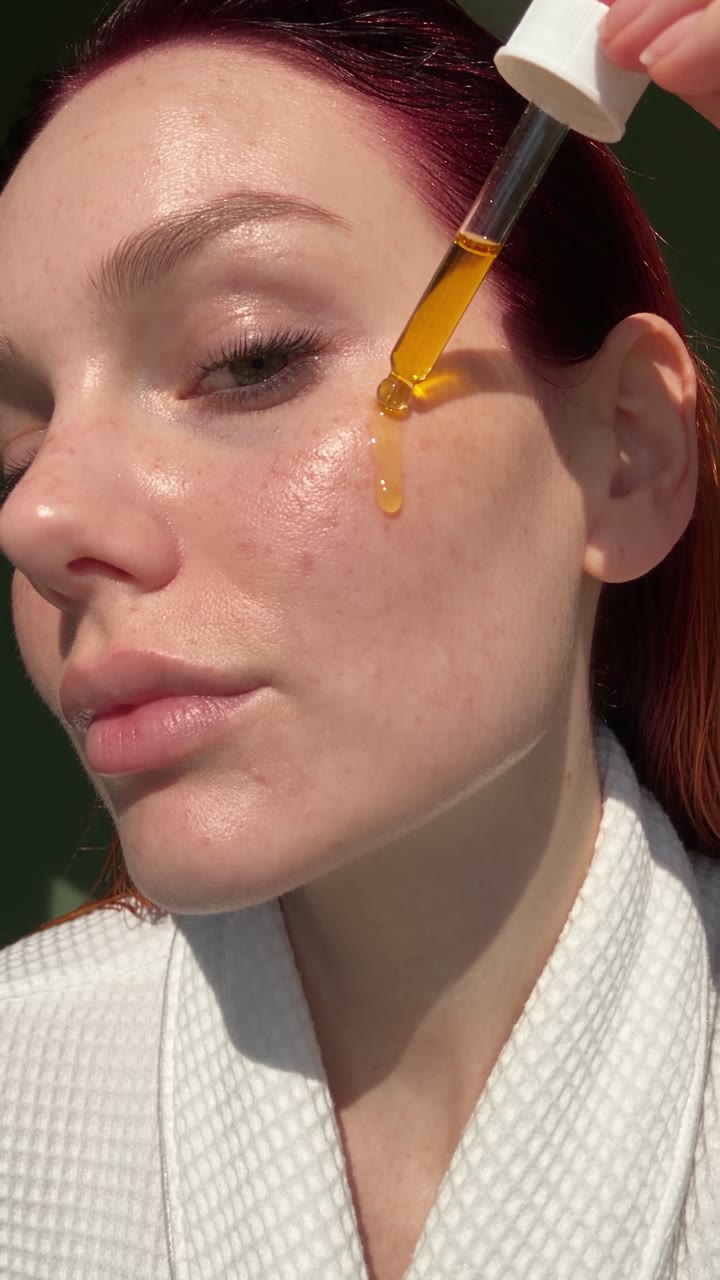
9-11 s: cut to a close-up of her cheek and neck, her head turned three-quarters away from camera. She holds the dropper above her cheekbone and releases two drops onto the upper cheek; they run slowly downward across the skin.
11-13 s: cut to a frontal close-up of her face. Her fingertips work the oil across both cheeks, then both palms press and smooth it along the cheeks and jawline with gentle patting movements until it is absorbed. Her eyes stay lowered toward her own hands.
End state: the oil is absorbed, her skin carries a soft even sheen, her hands lower out of frame.
STAGE 4 — 13 TO 15 SECONDS 13-15 s: close-up, her face front to camera. She raises the closed bottle beside her cheek and holds it there, lifts her eyes to the lens, and gives a small closed-mouth smile that reaches her eyes.
End state: the bottle is held beside her face, her gaze is on the lens.
AUDIO — VOICEOVER A female off-screen voiceover speaks in natural, warm, conversational American English at an easy unhurried pace, as if talking to a friend. Her lips do not move at any point — this is narration over the footage, not speech delivered on camera.
0-2 s: This is my secret to glowing, hydrated skin.
2-4 s: It’s the 100% Organic Cold-Pressed Rose Hip Seed Oil by The Ordinary.
5-8 s: It hydrates, supports skin elasticity, and gives you that glow.
8-11 s: It’s an oil-based formula, soft and smooth on the skin.
11-13 s: Apply it in the evening, after your water-based products.
13-15 s: You won’t regret it.
AUDIO — SOUND DESIGN Quiet room tone throughout. A soft cardboard rustle as the carton flap moves at 2 s. A light glass-on-glass tap as the dropper clears the bottle rim at 3 s. A small soft squeeze of the silicone bulb at 4 s. A faint wet friction of fingertips against skin from 11 to 13 s. No music.
MAINTAIN CONSISTENCY One woman throughout, the same face and hair colour as Image 3 in every shot. One bottle and one carton in the entire video, never two of either. Her hair stays equally wet from the first frame to the last — it does not dry, loosen, or fall forward. The white robe stays identical in every shot. Her hands stay bare in every shot. The bottle’s label artwork stays identical to Image 1 wherever it is visible. The deep green wall stays behind her and stays out of focus in every shot. The warm side light comes from camera left in every shot.
DO NOT No on-screen text of any kind: no captions, no subtitles, no titles, no overlay plates, no burned-in words, no watermark, no timecode, and no logos other than the label printed on the product itself. No panel grid or split-screen layout carried over from Image 1. No second bottle carried over from Image 2. No dry or loose hair. No rings, bracelets, watches, or coloured nail polish. No green light and no green colour cast on her skin. No sofa, no plants, no clutter in frame. No fast or jittery movement — every hand movement and every camera movement is slow and smooth. No zoom other than the single slow push-in at 3 to 4 seconds.
What holds the video together
Four habits here transfer to any product video you write.
Per-second beats. Stage 1 is not “she unboxes it”. It is 0-1 s, 1-2 s, 2-3 s, 3-4 s, each with its own shot. Eleven cuts in fifteen seconds, all written down.
An end state on every stage. Each stage finishes by naming exactly what the frame contains. The next stage starts from there. That is what stops four stages turning into four unrelated clips.
The voiceover on its own clock. The narration has its own timecodes, and one line says her lips never move. So the model does not have to lip-sync, and the words do not have to sit inside a shot.
A do-not list with names. Not “avoid artifacts” but: no second bottle, no panel grid, no dry hair, no green cast on her skin, no zoom except the one at 3 to 4 seconds. Each line kills a specific failure the pipeline can produce.
Swap in your own product
The panel layout is the part to rewrite carefully. Your product may not have a carton, or may not open. Write the six panels by asking one question: which states does the video actually show? The source sheet has exactly four — closed carton, carton open with the bottle rising, closed bottle, open bottle with the dropper out. The video needs all four, so the sheet decides all four.
The voiceover is six short lines in fifteen seconds. If a line does not fit comfortably in its two or three seconds at a calm pace, cut words until it does.
Where it goes wrong
| What you got | The fix |
|---|---|
| The six panels show different bottles | “All six panels show the same single product. Do not invent variants” |
| The label is rewritten or blurred | “Identical wording, typeface, weight, line breaks” — and do not re-typeset |
| Panel numbers or captions on the sheet | The sheet’s CONSTRAINTS block bans them |
| Two bottles in the video | Image 2 has two. Say “the video contains only one bottle” |
| A split-screen grid in the video | “Do not reproduce the panel grid, the panel divisions” |
| Her hair dries out mid-video | “Her hair stays equally wet from the first frame to the last” |
| Green light on her skin | “The green wall stays unlit” plus “no green colour cast on her skin” |
| Her lips move during narration | “Her lips do not move at any point — this is narration over the footage” |
| Captions burned into the frame | The DO NOT block bans on-screen text of any kind |
Why this workflow runs here
Images and video in one place
Free to start
Minutes, not days
Make yours in the next 30 min
You have the whole prompt and every setting. The only thing left is an account, and that takes a minute.
- Free to start
- Prompts ready to paste
- Upgrade only if you want more
Referral link — if you subscribe I earn a commission, at no extra cost to you. More on that.